Travel nurses may put more highway miles on a car in one assignment than some people drive in months.
That makes a roadside emergency kit worth carrying.
A good kit will not fix every mechanical problem, but it can make common situations safer and easier while you wait for help.
The best roadside emergency kit for a travel nurse should cover:
- Visibility
- Basic first aid
- Minor tools
- Tire problems
- Battery problems
- Weather exposure
- Communication backup
No prepacked kit is perfect, so the smartest approach is often to buy a solid base kit and add a few high-value items yourself.
Affiliate note: This article may contain affiliate links. If you buy through a link, we may earn a commission at no extra cost to you.
Shopping for roadside emergency kits for travel nurses?
Quick Picks
| Kit Type | Best For | What to Look For |
|---|---|---|
| AAA-style roadside kit | Best overall starter | Reflective gear, cables, flashlight, tools |
| Lifeline-style emergency kit | Best comprehensive option | Larger assortment and first-aid basics |
| Compact roadside bag | Best small-car option | Core essentials in minimal space |
| Winter roadside kit | Best cold-weather assignments | Blanket, scraper, traction aids, gloves |
| DIY custom kit | Best for serious travelers | Better individual components |
1. AAA-Style Roadside Emergency Kit – Best Overall Starter
Roadside kits sold under established automotive or roadside-assistance brands are usually a good place to start.
A typical kit may include:
- Jumper cables
- Flashlight
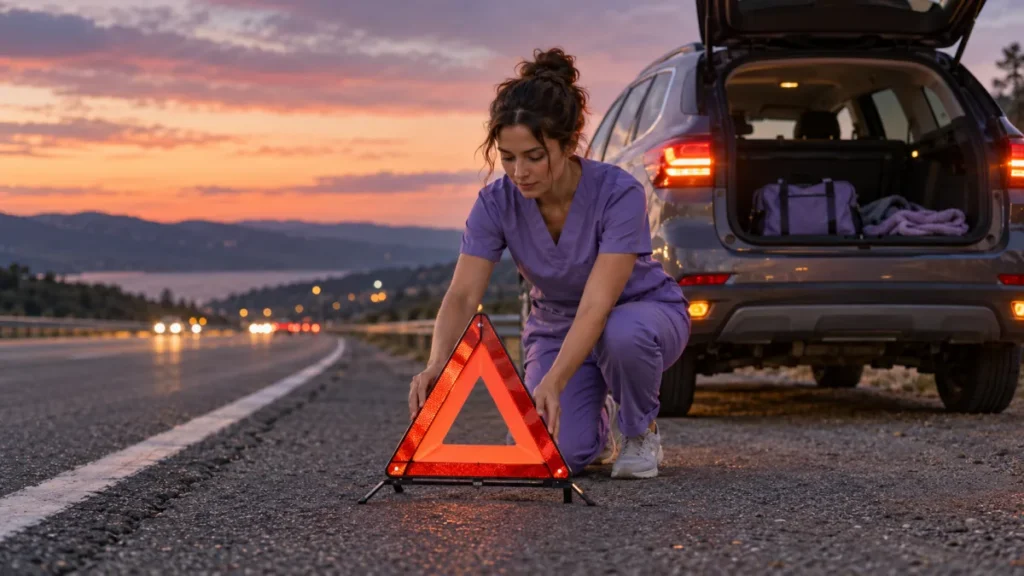
- Reflective triangle
- First-aid basics
- Work gloves
- Screwdrivers
- Emergency poncho
- Tire-pressure gauge
Why it works for travel nurses
It gives you the basic categories in one organized bag.
You can then add a portable jump starter and tire inflator.
Potential downside
Individual components in all-in-one kits are often basic rather than premium.
Best for: Nurses who currently have no emergency gear at all.
Affiliate link: Check current roadside emergency kits on Amazon
2. Lifeline-Style Comprehensive Emergency Kit – Best for Long Assignments
Larger emergency kits usually include more tools and supplies than compact starter kits.
Depending on the model, you may get:
- Jumper cables
- Tow rope
- Reflective warning gear
- Gloves
- First-aid supplies
- Flashlight
- Basic tool kit
- Cable ties
- Emergency poncho
Why we like it
A larger kit can provide a useful base for nurses driving hundreds or thousands of miles between assignments.
Potential downside
Some large kits look impressive because they advertise a huge item count, but many pieces may be tiny first-aid items or low-value extras.
Do not buy based on the number printed on the bag.
Best for: Travel nurses who make frequent long-distance drives.
3. Compact Roadside Kit – Best for Small Cars
If you drive a small sedan, hatchback, or already carry a lot of assignment gear, a huge emergency bag may be annoying.
A compact kit should prioritize:
- Reflective triangle
- Flashlight
- Gloves
- Tire gauge
- Basic tools
- First aid
Then carry a separate inflator and jump starter.
Why it works
You get the essentials without sacrificing trunk space.
Best for: Nurses who travel light.
4. Winter Emergency Kit – Best for Cold-Weather Assignments
A Florida nurse heading to Minnesota needs a different car kit than someone driving around Southern California.
For winter assignments, add:
- Ice scraper
- Snow brush
- Warm blanket
- Gloves
- Hat
- Hand warmers
- Traction aid
- Small shovel if appropriate
- Winter windshield fluid
- Extra warm clothing
A generic roadside kit should be treated as the base, not the whole winter setup.
5. DIY Emergency Kit – Best Overall Quality
If you care more about quality than convenience, build your own.
A DIY kit lets you choose reliable versions of the items that matter most.
Core DIY Kit
- Portable tire inflator
- Portable jump starter
- Tire-pressure gauge
- Reflective triangles
- Reflective vest
- Flashlight or headlamp
- Work gloves
- First-aid kit
- Multi-tool or compact tool kit
- Emergency blanket
- Paper towels
- Trash bags
- Bottled water
- Shelf-stable snack
This often produces a better kit than buying a 100-piece bag full of cheap accessories.
The Most Important Items
If your budget is limited, prioritize these first.
1. Reflective Warning Gear
Visibility is critical if you stop beside a road at night.
Carry:
- Reflective triangle
- Reflective vest
Use them only when it is safe to exit the vehicle.
2. Flashlight or Headlamp
A headlamp is especially useful because it keeps both hands free.
Choose a model with:
- Good battery life
- Easy controls
- Spare batteries or rechargeable power
Do not rely solely on your phone.
3. Tire Inflator
Low tire pressure is a common problem and often fixable without roadside assistance.
A portable inflator should have:
- Digital gauge
- Automatic shutoff
- Built-in light
- Adequate cord length or battery capacity
4. Portable Jump Starter
A portable jump pack is more useful for solo travelers than traditional jumper cables because it does not require another car.
Check:
- Engine-size compatibility
- Battery capacity
- Safety protections
- Charge level
Recharge it periodically.
5. First-Aid Kit
Keep a basic first-aid kit for personal emergencies.
It does not need to resemble a hospital supply cart.
Basic supplies are enough for small cuts and routine issues while traveling.
Jumper Cables vs Portable Jump Starter
Traditional jumper cables are inexpensive and reliable, but they require another vehicle.
A portable jump starter costs more but works independently.
For travel nurses who drive alone, the jump starter is usually more useful.
Keeping both is reasonable if space allows.
Tow Rope: Useful or Not?
A tow strap can be useful in certain situations, but towing or recovering a stuck vehicle can be dangerous when done incorrectly.
If you do not know how to use recovery equipment safely, call roadside assistance instead.
Do not assume every vehicle attachment point is designed for towing.
Does a Kit Need Road Flares?
Traditional burning flares can be hazardous and may not be allowed or appropriate everywhere.
Reflective triangles and battery-powered LED warning lights are often easier to store and reuse.
Choose gear you know how to deploy safely.
What About a Fire Extinguisher?
Some drivers carry a compact automotive-rated fire extinguisher.
If you do, secure it properly and choose one rated for appropriate vehicle fire types.
Do not attempt to fight a vehicle fire that puts you at risk.
Move away and call emergency services when appropriate.
Add Roadside Assistance
An emergency kit is not a replacement for roadside assistance.
Travel nurses may have coverage through:
- Auto insurer
- AAA
- Vehicle manufacturer
- Credit card
- Cell-phone plan or other membership
Check what you already have.
Save the contact number in your phone.
Best Kit for Solo Travel Nurses
For solo driving, prioritize tools that do not require help from another motorist.
That means:
- Portable jump starter
- Tire inflator
- Phone charger
- Battery bank
- Reflective warning gear
- Flashlight
- Roadside assistance
Self-contained gear is especially valuable late at night.
Best Kit for Cross-Country Assignments
For long-distance moves, add:
- Water
- Snacks
- Blanket
- Paper maps or offline maps
- Extra charging cable
- Weather-specific gear
- Tire repair supplies if you know how to use them
Check the route before leaving so the kit matches the conditions you will cross.
Best Kit for Hot-Weather Assignments
Add:
- Water
- Sun shade
- Light towel
- Hat
- Portable battery backup
Do not leave temperature-sensitive medications or electronics in extreme heat.
Best Kit for Winter Assignments
Add:
- Blanket
- Gloves
- Hat
- Ice scraper
- Snow brush
- Traction aid
- Winter windshield fluid
- Warm layers
Keep the gas tank from running extremely low during severe cold.
Follow local weather and emergency guidance.
What to Look for When Buying a Roadside Kit
Organized Case
A zippered bag or hard case is better than loose gear rolling around the trunk.
Useful Components
Ignore inflated item counts.
Look at what is actually included.
Reflective Equipment
At least one warning triangle or equivalent visibility item is important.
Gloves
Work gloves are inexpensive and surprisingly useful.
Flashlight
Make sure it is not an extremely weak novelty light.
First Aid
Basic supplies are useful, but this does not need to be the main feature.
What Prepacked Kits Often Miss
Many all-in-one kits do not include the two most useful modern roadside devices:
- Portable jump starter
- Portable tire inflator
Budget for those separately.
Also consider adding:
- Battery bank
- Better flashlight
- Better tire gauge
- Emergency blanket
- Water
- Snacks
Store the Kit Where You Can Reach It
Do not bury emergency gear under six bins of apartment supplies.
Keep it:
- In the trunk near the opening
- Behind a seat
- In an accessible cargo compartment
You should be able to reach it without unloading the car.
Check the Kit Every Few Months
Before every assignment move:
- Charge jump starter
- Charge flashlight
- Test tire inflator
- Check first-aid expiration dates
- Replace used items
- Inspect cables
- Add seasonal gear
- Check water and snacks
Emergency gear only helps if it works.
Final Thoughts
The best roadside emergency kit for a travel nurse is usually not one giant prepacked bag.
It is a solid starter kit combined with a few better standalone tools.
At minimum, carry:
- Reflective gear
- Flashlight
- First-aid basics
- Portable tire inflator
- Portable jump starter
- Work gloves
- Phone power
- Roadside-assistance information
That setup covers far more realistic problems than a kit filled with dozens of tiny accessories you will never use.
Related Reading
- What Travel Nurses Should Keep in Their Car
- Best Tire Inflators for Travel Nurses
- Best Portable Jump Starters for Travel Nurses
- Road Trip Packing Checklist for Travel Nurses
- How to Prepare Your Car for a Travel Nurse Assignment
Ready to pick one?